
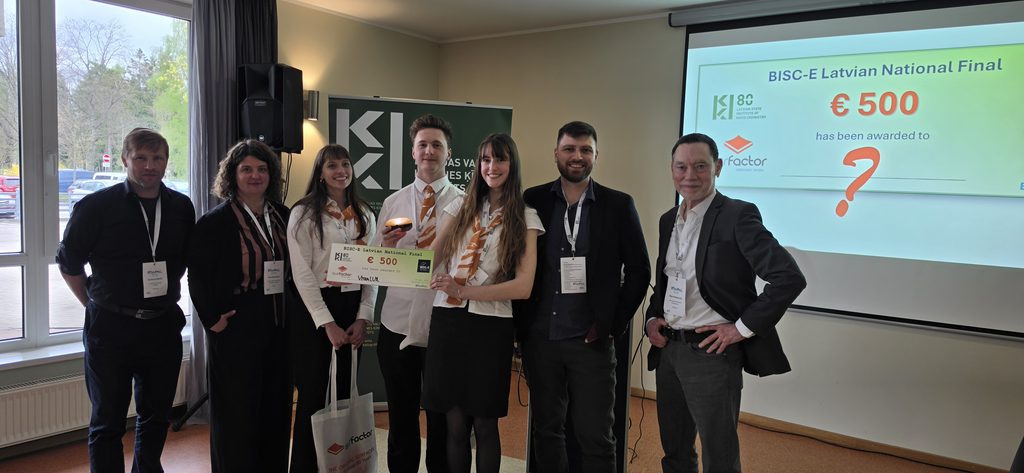
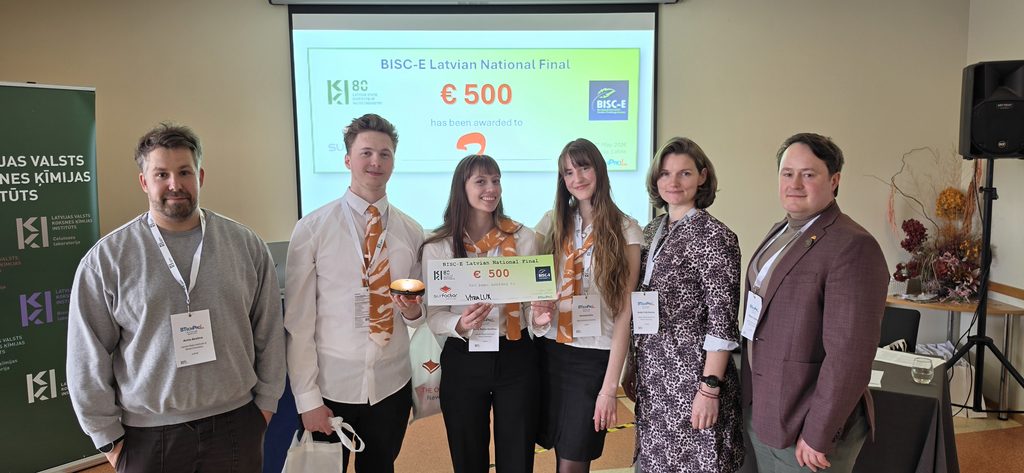
On 7 May 2026, team VitraLux won the Latvian final of the Bio-based Innovation Student Challenge Europe (BISC-E), earning the opportunity to represent Latvia in the European competition. The team’s concept was selected by the jury as the strongest among the national finalists and advanced to compete with student teams from across Europe.
The achievement also demonstrates how research developed within the BioCAN project can inspire new applications beyond the laboratory. The VitraLux team used a bio-based recyclable vitrimer resin developed within the BioCAN project at the Latvian State Institute of Wood Chemistry (LSIWC) to manufacture their prototype lighting objects.
From BioCAN research to a student-designed product
The VitraLux team — Anna Rēzija Āboltiņa, Daniela Kūla, and Ričards Varens — developed portable lighting objects combining innovative materials with sleep-supportive lighting design. Instead of relying on conventional fossil-based plastics, the students explored the use of a bio-based vitrimer material developed within BioCAN.
Vitrimers are an emerging class of polymer materials that combine the performance and dimensional stability of conventional thermosets with dynamic chemical bonds that enable new possibilities for repair, reshaping and recycling. Within BioCAN, such materials are being developed from renewable feedstocks with the aim of creating more circular alternatives to conventional thermoset polymers.
By incorporating the BioCAN vitrimer resin into a functional prototype, VitraLux provided an excellent opportunity to demonstrate how advanced materials developed through research projects can be translated into tangible products and explored in completely new application areas.
“The VitraLux concept stood out because it brought an advanced material that we are developing in our research into an everyday product. Vitrimers are still an emerging class of polymers, and seeing students take a BioCAN material and transform it into a functional prototype demonstrates the potential of these materials beyond the laboratory. VitraLux successfully combines material innovation, circularity and a function aimed at improving human well-being,” noted Dr. Anda Fridrihsone, Leading Researcher at LSIWC and BioCAN project coordinator.
Supporting the next generation of bioeconomy innovators
In preparation for the competition, the students were mentored by researchers from the Polymer Laboratory of the Latvian State Institute of Wood Chemistry — Dr. Anda Fridrihsone, Dr. Miķelis Kirpļuks and researcher Mg. chem. Arnis Āboliņš — together with Ilze Gūtmane, Scientific Assistant at the RTU Institute of Architecture and Design.
The mentors supported the students in strengthening the scientific basis of their concept, understanding the properties and processing of the vitrimer material, developing the prototype and preparing their presentation for the national final.
Two teams — VitraLux and PLA-FiberLoop — participated in the Latvian final, presenting their bio-based innovation concepts to an international jury. The projects were evaluated based on their scientific and practical quality as well as their potential for further development and commercialisation.
The VitraLux success highlights an important aspect of the BioCAN project: advanced research materials can serve not only as scientific outputs but also as platforms for education, creativity and future innovation. Providing students with access to the BioCAN vitrimer resin enabled them to explore a new application for the material and demonstrate its potential through a real prototype.
Following their victory in Latvia, VitraLux will represent Latvia in the European stage of BISC-E, bringing a student innovation based on BioCAN research to an international audience.
About BISC-E
The Bio-based Innovation Student Challenge Europe (BISC-E) is an annual student competition organised by the Bio-based Industries Consortium (BIC). It encourages students to develop innovative products and technologies based on renewable biological resources and promotes entrepreneurship, excellence in bio-based research and greater awareness of the European bioeconomy.
For BioCAN, the VitraLux story provides a practical example of how research into recyclable bio-based vitrimer materials can reach beyond scientific publications and laboratories — inspiring young innovators and opening possibilities for entirely new applications.